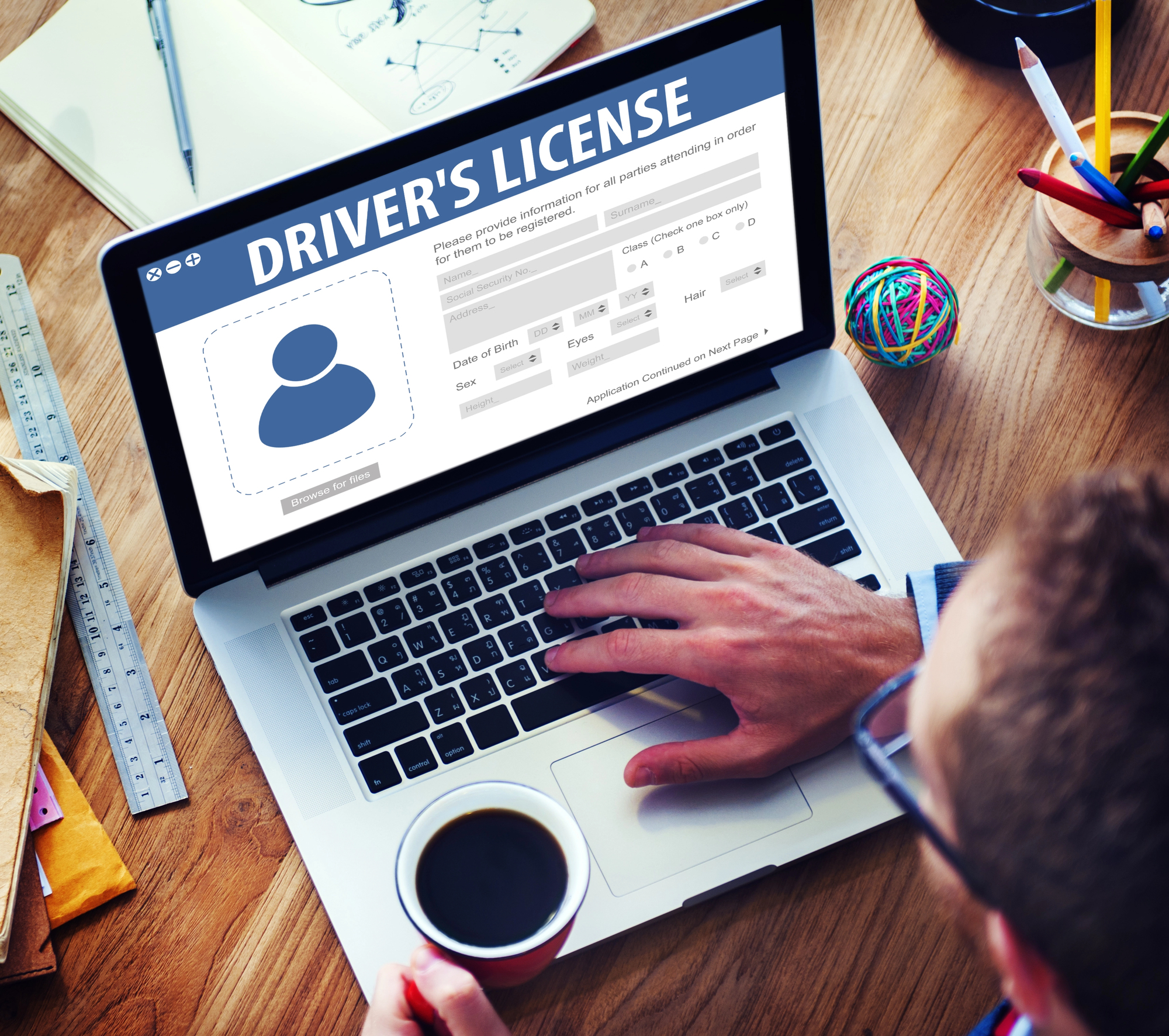


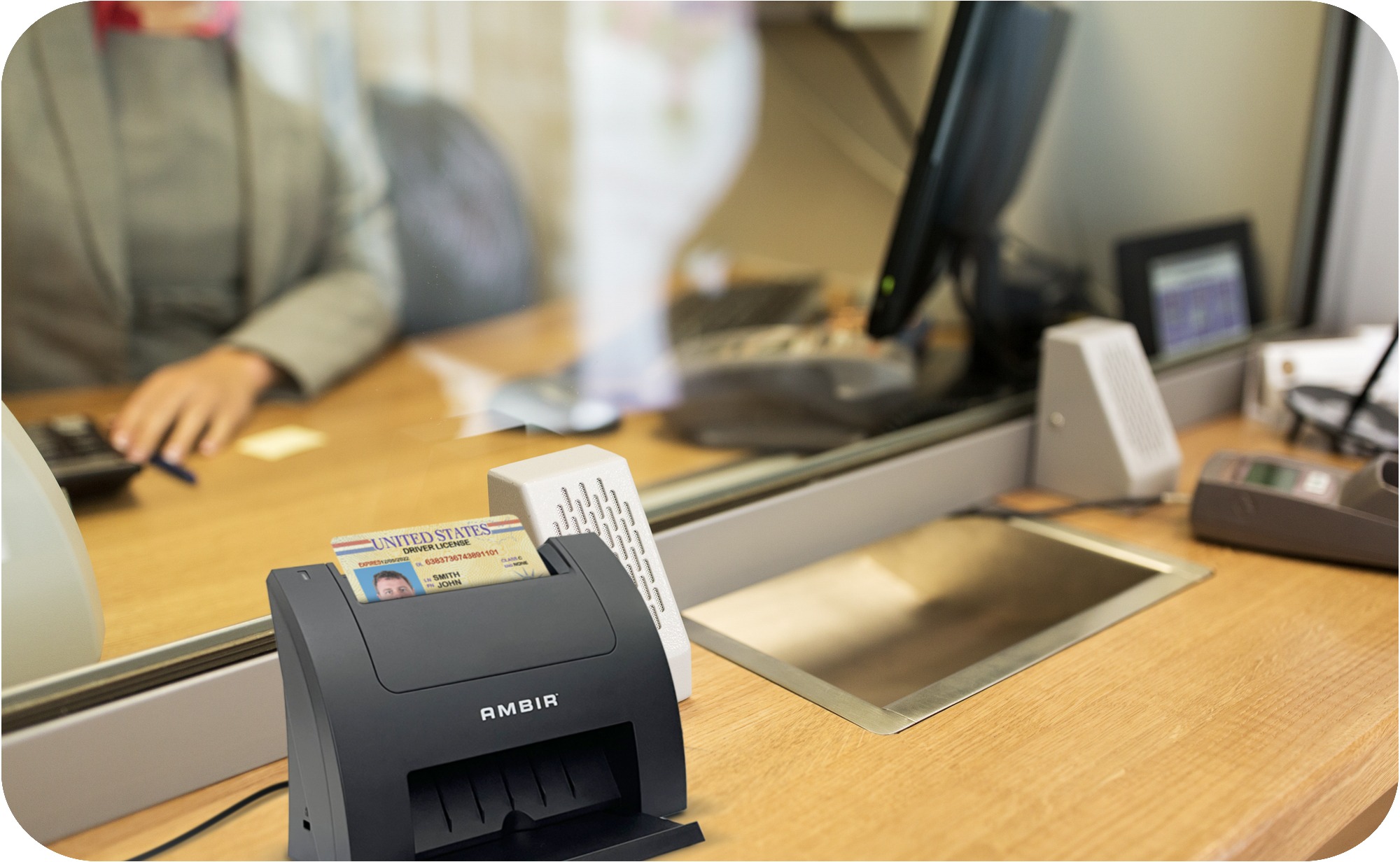
With synthetic identity fraud exposure reaching $3.3 billion and deepfake attempts surging by 2,137 percent, the teller line has become a high-stakes security checkpoint. Implementing a high-performance ID scanner for financial institutions is the most effective way to harden these defenses while maintaining operational speed. You’re likely already feeling the pressure from FinCEN’s 2026 AML overhaul, where manual data entry errors aren’t just an inconvenience; they’re a significant compliance risk that can lead to severe penalties.
This guide explains how specialized scanning hardware secures transactions, ensures rigorous KYC compliance, and removes administrative friction from your branch workflows. We’ll analyze the technical synergy between forensic-level imaging and banking software, focusing on how the ImageScan Pro and nScan series provide the fast OCR extraction and compact footprints required for modern teller lanes. By bridging the gap between analog identification and digital banking cores, these solutions provide the reliability and peace of mind necessary for high-stakes professional environments. We’ll also examine the importance of localized support and TWAIN compatibility in maintaining a resilient, future-proof infrastructure.
Key Takeaways
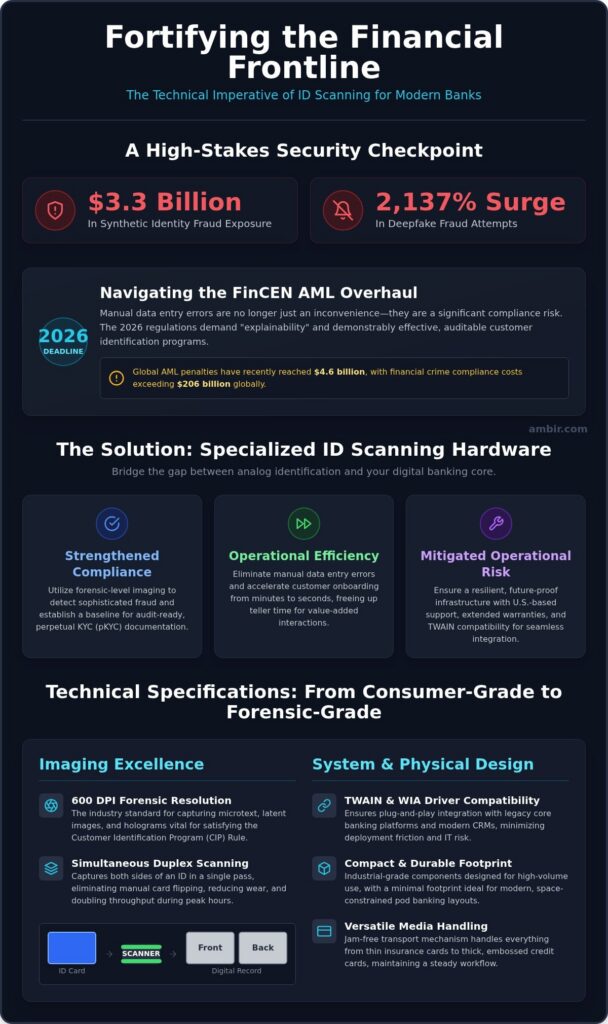
- Navigate the 2026 AML overhaul and FinCEN regulations by utilizing high-resolution forensic imaging to detect sophisticated fraud attempts.
- Establish a baseline for audit-ready documentation by implementing 600 DPI duplex scanning to capture both sides of an ID in a single pass.
- Discover how a specialized ID scanner for financial institutions integrates with OCR software to eliminate manual data entry and accelerate customer onboarding.
- Select hardware with a compact footprint to maintain teller productivity and ergonomics in modern pod-based banking environments.
- Mitigate operational risk through U.S.-based technical support and extended hardware warranties designed for high-volume professional settings.
The Critical Role of ID Scanning in Modern Financial Compliance
Regulatory compliance in 2026 requires more than simple document collection. FinCEN’s April 13, 2026, proposal moved the industry toward layer-specific operational standards for customer identification, monitoring, and reporting. This means every component of your program must be separately auditable and demonstrably effective. Deploying a dedicated ID scanner for financial institutions ensures that your institution meets these rigorous standards while protecting against the $4.6 billion in global AML penalties seen in recent years. It’s about moving from periodic reviews to the perpetual KYC (pKYC) model regulators now expect.
Strengthening KYC and AML Workflows
Digital capture creates a permanent, high-fidelity record that manual transcription cannot match. By utilizing a professional identity verification service alongside forensic-level scanning hardware, banks can detect the subtle anomalies found in synthetic IDs. Synthetic identity fraud exposure reached $3.3 billion at the end of 2024; catching these sophisticated fakes requires the clarity provided by specialized imaging. Digital workflows also remove the risk of human error during high-stress teller interactions. Automated capture ensures that data points like expiration dates, document numbers, and security features are recorded accurately every time, providing the “explainability” that 2026 regulations demand for all compliance decisions.
Operational Efficiency and Customer Experience
Manual data entry is a primary source of administrative friction. Transitioning to automated scanning allows tellers to populate customer profiles in seconds rather than minutes. This speed is critical during peak hours when slow onboarding times directly impact customer satisfaction. High-speed scanning hardware, such as the ImageScan Pro series, streamlines loan applications and new account openings at the point of service. You can explore these financial solutions to see how hardware and software synergy reduces the massive costs associated with financial crime compliance, which now exceeds $206 billion globally. It’s a pragmatic upgrade that enhances the branch’s professional image while hardening security. Data consistently shows that institutions using automated verification experience significantly fewer compliance-related fines and faster throughput during peak hours. This correlation between automation and reduced risk is a key driver for IT departments looking to mitigate operational exposure.
Technical Specifications: What Financial Institutions Must Demand
Selecting an ID scanner for financial institutions requires a shift in focus from consumer-grade speed to forensic-grade precision. While basic scanners might capture a legible image, they often fail to record the fine details required for legal verification. At 600 DPI, it’s the industry standard for forensic clarity. This resolution, combined with 24-bit color depth, allows for the accurate capture of microtext, latent images, and holograms found on modern government-issued IDs. These details are vital for satisfying the Customer Identification Program (CIP) Rule, which mandates that institutions verify the identity of every person opening an account.
Imaging Excellence: Beyond Basic Scanning
Efficiency at the teller lane depends on hardware that completes tasks in a single motion. Duplex scanning is non-negotiable for this environment. Devices like the nScan 690GT capture both sides of an ID card simultaneously, eliminating the need for tellers to flip cards and re-scan. This reduces mechanical wear and doubles throughput during peak hours. The hardware must also handle a range of media thicknesses. From thin insurance cards to embossed credit cards, the scanner’s transport mechanism must remain jam-free to avoid administrative friction. Reliable hardware maintains a steady workflow, even during the busiest branch hours.
System Synergy and Driver Compatibility
Software integration is the most common failure point in hardware deployments. For hardware to be useful, it must communicate seamlessly with legacy core banking platforms and modern CRMs. TWAIN and WIA driver compatibility ensures that the scanner functions as a plug-and-play asset within existing software environments. TWAIN compatibility serves as the essential bridge between scanner hardware and banking software. High-speed USB interfaces further minimize latency, ensuring that data moves from the physical card to the digital profile without delay. For IT departments, choosing hardware with robust, updated drivers is a critical risk-mitigation factor.
Physical durability is the final technical pillar for high-volume environments. Financial institutions often process hundreds of scans per day, requiring industrial-grade components that exceed consumer specifications. A compact footprint is equally important, as desk space in modern pod banking layouts is limited. Choosing a scanner with a minimal footprint ensures that the hardware doesn’t interfere with the teller’s workspace or customer interaction. When evaluating your options, consider exploring the full range of ID card scanners designed specifically for these high-stakes settings. These units are engineered for longevity, backed by localized support to ensure your operations never stall due to hardware failure.
Evaluating Software Integration and Automated Data Parsing
High-performance hardware requires equally sophisticated software to maximize ROI. An ID scanner for financial institutions acts as the physical entry point, but Optical Character Recognition (OCR) is the engine that converts that image into actionable data. By automating the extraction of names, addresses, and ID numbers, banks can eliminate the primary source of onboarding friction: manual data entry. This process doesn’t just save time; it ensures the accuracy of the data entering your banking core, reducing the risk of manual transcription errors that lead to compliance flags.
Automated Data Extraction with OCR
Modern OCR goes beyond simple character recognition. It accurately reads the 1D and 2D barcodes, specifically the PDF417 format, found on the reverse side of government-issued licenses. This allows for immediate cross-matching between the visual data on the front and the encoded data on the back. If the data points don’t align, the system flags the document for manual review, providing an instant layer of fraud prevention. You can learn more about our AmbirScan BCS solutions to understand how this parsing integrates directly into your existing CRM or banking core.
The data flow moves seamlessly from the physical ID through the scanner to the AmbirScan software, which then parses the information into the appropriate fields in the database. This eliminates the need for tellers to type sensitive information manually, which is where most transcription errors occur. In high-volume branches, these saved minutes aggregate into significant operational gains and shorter wait times. It ensures that the administrative friction often found in account opening is minimized, allowing staff to focus on high-value customer interactions rather than repetitive keyboard entry.
Security and Data Privacy in the Capture Process
Handling Personally Identifiable Information (PII) requires strict adherence to security protocols. Compliance with SOC 2 and other financial data standards is a prerequisite for any software integration. Professional capture solutions ensure that scanned data is encrypted during transit to the central server. To maintain a clean digital footprint, the software should avoid local storage of sensitive images or data on the teller’s workstation. This architecture protects the institution from data breaches at the endpoint. It ensures that all captured information is stored only within the secured, auditable banking environment. By prioritizing system synergy and data privacy, institutions can deploy these tools with confidence in their security posture.
Form Factor and Ergonomics: Matching Hardware to the Workflow
Branch architecture is evolving rapidly. The traditional, expansive teller line is being replaced by agile “pods” and self-service kiosks. This shift makes the physical footprint of an ID scanner for financial institutions a primary consideration for IT departments and branch managers. Space on a banking pod is a premium asset. Large, traditional flatbed scanners are no longer practical in these environments. Smaller, specialized devices provide the same high-resolution capture without cluttering the customer interaction zone.
Desktop Solutions for the Teller Line
Choosing between vertical and horizontal feeding mechanisms impacts both ergonomics and processing speed. Vertical feed scanners, like the nScan 690GT, utilize gravity to assist the card path. This minimizes jams and significantly reduces the physical space required on the desk. This design allows tellers to drop an ID in and continue their conversation with the customer, maintaining eye contact and professional engagement. For administrative workstations where space is slightly more flexible, the ImageScan Pro 490ix offers a robust, horizontal path that’s ideal for consistent, high-volume card processing. You can explore our full range of financial document scanning solutions to find the exact dimensions that fit your specific branch layout.
Mobile and Portable Scanning for Field Agents
Financial services aren’t confined to the branch anymore. Loan officers and field agents frequently meet clients at homes or businesses, requiring a mobile ID scanner for financial institutions that doesn’t compromise on security or image quality. The TravelScan Pro PS600 solves this through a strictly USB-powered design. It eliminates the need for bulky external power bricks, allowing agents to scan IDs directly into their laptops while maintaining the forensic clarity required for compliance. This mobility ensures that the bridge between analog inputs and digital outputs is maintained even outside the office. Portable units must be durable enough to survive daily travel while remaining lightweight enough for a mobile briefcase. It’s about providing the same reliability in the field as you’d expect at the teller station.
Reliability in these varied environments is paramount. Whether it’s a fixed teller station or a mobile lending unit, the hardware must perform consistently under pressure. Ambir devices are engineered with these specific ergonomic needs in mind, ensuring that technology supports the workflow rather than hindering it. If you’re ready to optimize your branch footprint and improve staff productivity, you can view our complete product lineup to compare technical specifications and physical dimensions.
The Ambir Advantage: Reliability and Localized Specialist Support
Hardware performance is only one half of the equation in a high-stakes banking environment. The other half is the reliability of the vendor and the accessibility of technical assistance. For an IT department managing a fleet of devices, a dedicated ID scanner for financial institutions must be backed by a support structure that minimizes downtime. While many competitors rely on offshore call centers, localized assistance ensures that technical hurdles are cleared quickly by experts who understand the specific TWAIN and WIA requirements of American banking cores. This pragmatic approach to support is a critical risk-mitigation factor for institutions of all sizes, from single-branch credit unions to national enterprises.
Comprehensive Support and Warranty Protection
Peace of mind in a professional setting comes from knowing that hardware is built to last and fully protected if issues arise. Every Ambir device comes with a standard two-year warranty, providing a significantly higher ROI compared to the one-year industry standard. This coverage reflects a commitment to the durability of the ImageScan Pro and nScan series. When tellers encounter administrative friction, they have direct access to U.S.-based support headquartered in Wood Dale, Illinois. These specialists don’t just troubleshoot hardware; they understand the system synergy required to keep teller lanes moving during peak hours. You can browse our complete Ambir products catalog to see the full range of solutions backed by this localized expertise.
Built for Longevity and Performance
Longevity is achieved through a combination of robust mechanical engineering and proper maintenance. Financial institutions often process thousands of IDs per month, which introduces dust and debris into the scanner’s internal sensors. Using genuine scanner cleaning kits is essential for maintaining the 600 DPI forensic clarity required for compliance audits. Ambir’s hardware is engineered to withstand the physical demands of high-volume teller pods, utilizing high-grade components that resist wear over years of service. This focus on durability ensures that the bridge between analog inputs and digital outputs remains stable and efficient. Ambir has maintained a 20-year legacy of providing specialized digital capture solutions for high-stakes professional environments. By prioritizing smart engineering and accessible support, the brand remains a reliable specialist for the modern, agile workspace.
Secure Your Compliance Infrastructure for 2026
The regulatory landscape for 2026 demands a shift toward perpetual KYC and forensic-level document verification. By implementing a high-performance ID scanner for financial institutions, your branch can simultaneously harden its security against synthetic fraud and eliminate the administrative friction caused by manual data entry. Precision imaging at 600 DPI ensures that your audit trails meet the most rigorous standards, while compact hardware designs maintain teller productivity in modern pod environments. It’s about ensuring that your digital capture solutions are as agile as your workspace.
Reliability is the cornerstone of any specialized professional environment. Choosing a partner that offers U.S.-based technical support and a standard two-year warranty ensures that your hardware and software will work seamlessly when it matters most. Ambir has been trusted by healthcare and financial leaders since 2001 to bridge the gap between analog inputs and digital outputs with smart engineering. This long-term commitment to quality provides the peace of mind necessary for high-stakes financial operations.
Streamline your branch workflow with Ambir Financial Solutions and gain the peace of mind that comes with industry-leading reliability. Your institution is now better equipped to navigate the complexities of modern compliance with confidence.
Frequently Asked Questions
Why do banks need specialized ID scanners instead of standard flatbed scanners?
Specialized scanners provide 600 DPI forensic clarity and compact footprints designed specifically for teller pods. Flatbeds are often too slow and bulky for high-volume banking environments. Specialized hardware like the nScan 690GT also offers vertical feeding and duplex capture, which significantly reduces the time required for customer onboarding. Standard flatbeds lack the high-tech components and technical standards needed to detect sophisticated counterfeit documents effectively during a transaction.
Are Ambir ID scanners compliant with KYC and AML regulations?
Yes, Ambir hardware provides the high-resolution imaging necessary to satisfy the Customer Identification Program (CIP) Rule and FinCEN’s 2026 AML overhaul. By capturing security features like microtext and holograms at 600 DPI, an ID scanner for financial institutions creates a permanent, auditable trail for regulatory examinations. This high-fidelity digital capture helps mitigate the $3.3 billion exposure to synthetic identity fraud that many financial institutions currently face in the market.
Can these scanners read both the front and back of a drivers license simultaneously?
Yes, models like the nScan 690GT and ImageScan Pro 490ix feature duplex scanning technology that captures both sides of an ID in a single pass. This capability is essential for efficiency, as it allows for the simultaneous capture of visual data on the front and the PDF417 barcode on the back. Single-pass scanning reduces mechanical wear and eliminates the need for tellers to flip cards manually during high-pressure customer interactions.
Do Ambir ID scanners integrate with my existing banking software?
Ambir scanners utilize robust TWAIN and WIA drivers to ensure seamless synergy with legacy core banking platforms and modern CRMs. This broad compatibility serves as the essential bridge between the physical hardware and your digital database. Because these industry-standard protocols are maintained through regular driver updates, IT departments can deploy an ID scanner for financial institutions with confidence that it will function within their current software ecosystem without requiring custom coding.
What is the benefit of U.S.-based support for a financial institution?
Localized support based in Wood Dale, Illinois, provides immediate access to specialists who understand the high-stakes nature of financial workflows. This minimizes operational downtime by providing expert assistance for driver compatibility and hardware maintenance. For IT departments, having a reliable partner within the same regulatory and time-zone environment acts as a critical risk-mitigation factor, ensuring that branch technology remains functional and supported during peak business hours.
How long is the typical lifespan of an Ambir ID scanner in a high-volume branch?
Ambir hardware is engineered for longevity and high-volume performance, often processing hundreds of scans daily for several years. The standard two-year warranty reflects this commitment to durability and mechanical reliability. By using genuine scanner cleaning kits and following a regular maintenance cadence, institutions can extend the operational life of their devices. The robust engineering of the ImageScan Pro series is specifically designed to withstand the physical demands of a busy office.
Can these scanners read passports as well as ID cards?
While compact card scanners focus on IDs and insurance cards, Ambir offers specialized document scanners like the ImageScan Pro 800 series that handle larger formats including passports. These devices maintain the same forensic-level 600 DPI resolution required for international identity verification. It’s important to select hardware with a transport mechanism suited for the specific document dimensions your institution processes most frequently to ensure consistent image quality and transport reliability across all branches.
Do I need special software to extract data from the scanned IDs?
To automate data parsing, you should use specialized OCR software like AmbirScan BCS. This software transforms captured images into actionable data by reading 2D barcodes and visual text fields. Without this software, the scanner provides only an image file. AmbirScan BCS bridges the gap between analog inputs and digital outputs, allowing for the automated population of customer profiles and significantly reducing the time spent on manual typing during the onboarding process.
About AMBIR
AMBIR is a manufacturer of digital capture solutions for businesses and consumers. Headquartered in Chicago, IL and founded over 25 years ago on the premise of creating the highest quality hardware backed by hands-on support. AMBIR provides a variety of document and card scanners, eSignature pads and barcode scanners for various industries including healthcare, financial services, legal and more. We are known for being a hands-on organization who supports its clients with an internal team of dedicated professionals who know their clients by name. AMBIR is considered a market leading solution in the healthcare space due to it’s wide selection of products that integrate with leading EMR/EHR systems.