


Research from the University of Nevada indicates that manual data entry yields an error rate between 1% and 4%, which translates to thousands of corrupted records in high-volume healthcare or legal settings. When your workflow relies on legacy EHR or CRM systems, these inaccuracies don’t just slow down throughput; they compromise the integrity of your entire database. Integrating a high-performance barcode reader is no longer a luxury for specialized offices. It’s a technical necessity for maintaining a 99.9% data capture accuracy rate across all digital touchpoints.
You likely recognize that hardware downtime and software friction are the primary enemies of professional productivity. You need a scanning architecture that bridges the gap between physical documents and digital efficiency without constant troubleshooting. This guide provides the technical roadmap to master barcode fundamentals and select the specific hardware configurations required for high-stakes environments. We’ll examine TWAIN driver compatibility, decodability metrics, and the integration strategies that ensure your hardware remains a long-term asset rather than a legacy bottleneck.
Key Takeaways
- Master the technical fundamentals of light reflection and data capture to ensure high-precision accuracy within mission-critical professional environments.
- Eliminate the 3-5% error rate typical of manual entry by integrating automated capture solutions into specialized healthcare and finance workflows.
- Evaluate hardware based on duty cycle and environmental ruggedness to select the optimal code barre reader for high-volume, demanding workspaces.
- Utilize a strategic framework to align industry-specific symbologies with the unique lighting and distance requirements of your operational infrastructure.
- Leverage U.S.-based technical support and precision engineering to maintain business continuity and simplify the transition from physical to digital workflows.
Understanding Barcode Reader Technology and Data Capture Fundamentals
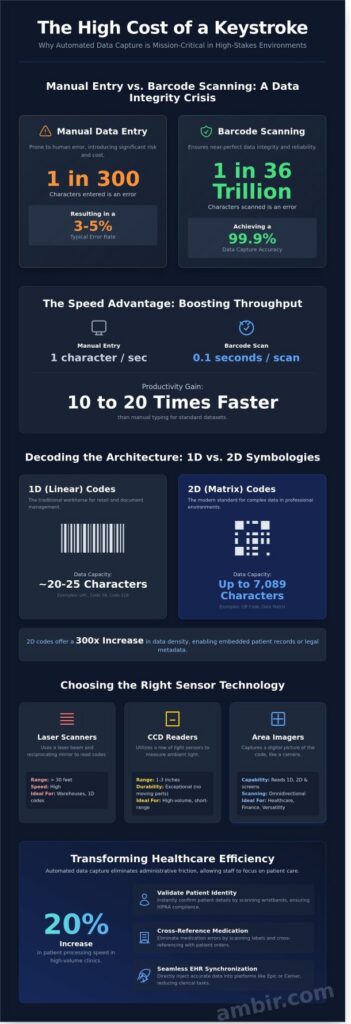
A barcode reader serves as a mission-critical data entry peripheral, acting as the primary bridge between physical assets and digital databases. Accuracy is the highest priority in professional workflows; manual data entry typically results in one error for every 300 keystrokes. In contrast, a high-quality barcode reader reduces that margin to less than one error in several million characters. This reliability is why industries like healthcare and logistics depend on these devices for high-stakes precision.
The core physics of data capture relies on light reflection. The scanner illuminates the barcode with a light source, such as a laser or LED. The dark bars absorb the light while the white spaces reflect it back into the device’s sensor. A photodiode or CMOS sensor converts these light fluctuations into electrical signals. The internal decoder then translates these signals into text strings that a computer recognizes. In international professional standards, specifically those aligning with ISO/IEC 15416, the code barre reader remains the benchmark for ensuring global supply chain interoperability.
By 2026, the industry will complete a significant shift from simple inventory tracking to complex data management. Modern scanners no longer just identify an item; they capture expiration dates, lot numbers, and encrypted authentication data. This evolution turns a simple peripheral into a sophisticated tool for regulatory compliance and deep-level analytics.
1D vs. 2D Symbologies: Decoding the Architecture
Linear 1D codes like Code 39, Code 128, and UPC are the traditional workhorses of retail and document management. They represent data through varying widths of bars and spaces. While reliable, they’re limited to roughly 20 to 25 characters of information. Professional environments are rapidly transitioning toward 2D matrix codes like QR and Data Matrix. These symbologies utilize vertical and horizontal patterns to store up to 7,089 characters. This 30x increase in data density allows for the embedding of full patient records or detailed legal metadata within a square centimeter of space.
Laser vs. Imager vs. CCD: Choosing the Right Sensor
Selecting the correct sensor technology depends on your specific workspace requirements and the type of “code barre reader” functionality needed for your volume. The three primary sensor types include:
- Laser Scanners: These use a reciprocating mirror to sweep a laser beam across the code. They offer high speed and can read 1D codes from distances exceeding 30 feet, making them ideal for warehouse environments.
- CCD (Charge-Coupled Device) Readers: These utilize a row of tiny light sensors to measure the ambient light from the barcode. Because they have no moving parts, they’re exceptionally durable, though they require a short scanning range of 1 to 3 inches.
- Area Imagers: Utilizing CMOS technology similar to digital cameras, area imagers capture a full picture of the code. They support omnidirectional scanning and are required for reading 2D symbologies or scanning from digital screens.
For offices prioritizing space-saving and efficiency, area imagers provide the most versatile solution for modern data capture needs.
The Evolution of Barcode Reader Scanning: Driving Efficiency in Healthcare and Finance
Manual data entry is a significant liability in high-stakes environments. Industry benchmarks indicate that manual keyboard entry results in an error rate between 3% and 5%. In a hospital or bank, these mistakes aren’t just inconvenient; they’re costly and dangerous. Transitioning to a professional code barre reader eliminates these human variables. Automated data capture ensures near-perfect accuracy, providing a level of reliability that manual processes can’t match. This shift is essential for organizations looking to optimize throughput and reduce the overhead associated with data correction.
Infographic: Manual Entry Speed vs. Barcode Throughput
- Manual Entry: Average speed of 1 character per second with a 1 in 300 error rate.
- Barcode Reader Scanning: Average speed of 0.1 seconds per scan with a 1 in 36 trillion error rate.
- Productivity Gain: Scanning is approximately 10 to 20 times faster than manual typing for standard data sets.
Integrating scanning technology into healthcare solutions transforms patient safety. When a clinician scans a patient wristband, the system instantly validates identity and cross-references medication orders. This direct data injection into platforms like Epic or Cerner removes administrative friction, allowing staff to focus on care rather than clerical tasks. High-volume clinics often see a 20% increase in patient processing speed after implementing automated capture workflows.
Patient Intake and EHR Synchronization
Clinics handling dozens of patients daily require seamless EHR synchronization to maintain HIPAA compliance. Scanning wristbands and medication labels ensures that every action is logged accurately within the digital record. Professional scanners facilitate this by providing high-speed capture that feeds directly into major EHR systems. This synchronization prevents the fragmentation of patient data, ensuring that records remain current across all departments in real time.
Secure Document Management and Audit Trails
In the financial sector, financial solutions rely on barcodes for Know Your Customer (KYC) protocols and regulatory adherence. A robust code barre reader can parse encrypted 2D barcode data, such as PDF417 formats found on government IDs, to verify identities instantly. This process creates an immutable digital audit trail. Using barcodes to index sensitive records ensures that every document is categorized correctly, meeting strict regulatory requirements without the risk of manual filing errors. If your workflow requires high-volume document indexing, exploring specialized barcode scanners can significantly reduce your processing time.
Critical Features for Professional High-Volume Environments
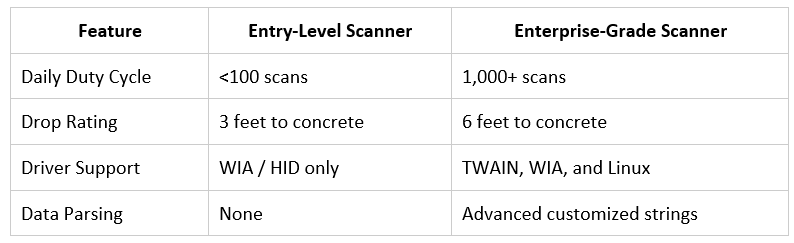
High-volume settings like healthcare registration desks or legal mailrooms require hardware that survives a 40-hour work week without failure. A professional code barre reader must offer a duty cycle that exceeds 500 scans per day. Entry-level consumer devices often lack the internal cooling and high-impact housing needed for these cycles. Professional-grade hardware is built with a Mean Time Between Failures (MTBF) rating of 50,000 hours or more, ensuring your workflow stays active during peak hours.
Efficiency starts with deployment. While “Plug-and-Play” functionality allows for immediate use, enterprise environments often require customized configuration. This includes the ability to program the scanner to add prefixes, suffixes, or character replacements to the scanned data. This level of control ensures the hardware integrates perfectly with your existing database architecture without manual data entry corrections.
Form factor selection depends on your physical workspace. Handheld scanners offer mobility for scanning large items, but integrated card scanners provide a fixed-position solution that eliminates desk clutter. A 2023 study on workspace optimization found that integrated peripherals reduce document handling time by 15% compared to handheld alternatives. This makes them ideal for high-traffic reception areas where space is at a premium.
Connectivity and Ergonomics
Modernizing your hardware means choosing between USB-A and USB-C. USB-C offers more robust power delivery and faster data transfer, making it the standard for future-proofing your office. If your team requires wireless mobility, be aware of 2.4GHz interference from office Wi-Fi, which can reduce scan success rates by 12% in dense environments. Ergonomic design is equally vital. Triggers with low-force activation reduce repetitive strain injuries, which cost U.S. businesses over $20 billion annually in workers’ compensation claims. Our barcode scanners are engineered to balance weight and grip to maintain comfort throughout full-shift operations.
A Strategic Framework for Selecting Your Barcode Reader
Deploying the right code barre reader requires a technical audit of your operational environment. You can’t rely on generic hardware when processing 1,000+ items daily in a high-stakes medical or legal setting. Start by identifying your industry’s primary symbologies. While retail relies on 1D UPC codes, healthcare facilities often require 2D Data Matrix scanning to manage unit-dose medications and patient wristbands. Your hardware must support these specific densities to ensure accurate data capture.
- Scanning Distance: Evaluate if your workflow requires “near-contact” scanning or long-range capabilities up to 30 feet for warehouse racking.
- Lighting Conditions: Scanners must handle ambient light variations from 0 to 100,000 lux to remain functional in both dark storage areas and bright loading docks.
- Durability: High-volume environments require an IP65 rating to protect against dust and water ingress.
- Software Environment: Determine if you need TWAIN-compliant drivers for direct EHR integration or a standalone cloud-based interface for mobile fleet management.
Assessing Throughput and Volume Requirements
Efficiency is measured in seconds. If a high-speed scanner reduces scan time by 4 seconds per cycle across 500 daily transactions, a single workstation gains over 80 hours of productivity annually. Peak traffic periods, such as end-of-quarter inventory audits, demand hardware that maintains a 99.9% first-read success rate. Low-quality readers increase “no-reads,” forcing manual data entry which averages a $25 cost per error according to industry labor benchmarks. Matching your code barre reader speed to these peak loads prevents bottlenecks in your data pipeline.
Optimize your data capture workflow with professional-grade barcode scanners designed for high-throughput environments.
Ambir Barcode Solutions: Precision Engineering for Critical Workflows
Reliability isn’t optional in high-stakes environments like healthcare clinics or legal offices. A malfunctioning code barre reader creates immediate bottlenecks that impact patient care or case management. Ambir Technology addresses these friction points with hardware designed for the modern, agile workspace. Ambir Technology’s barcode scanners are engineered for 24/7 reliability; they’re backed by a two-year standard warranty that exceeds the standard one-year coverage typically offered by competitors. This commitment to longevity ensures that enterprise hardware maintains 2026-level performance standards throughout its entire lifecycle.
Choosing a U.S.-based partner provides a critical differentiator for business continuity. When hardware is integrated into a mission-critical workflow, waiting days for international support isn’t an option. Ambir Technology provides direct access to domestic experts who understand the specific demands of high-volume data environments. This localized support model ensures that technical configurations and troubleshooting happen in real-time, keeping your front desk or shipping hub operational without interruption.
Comprehensive Support and Hardware Longevity
Business continuity relies on rapid resolution when technical hurdles arise. Ambir Technology provides specialized U.S.-based technical support to ensure that downtime remains minimal. Accessing a live expert in the United States means technical issues are often resolved in a single call, rather than through lengthy email chains. These experts understand the specific needs of HIPAA-compliant environments and complex legal workflows.
- Rapid Resolution: Direct phone access to technicians minimizes operational delays.
- Performance Maintenance: Regular software updates ensure compatibility with the latest operating systems.
- Enterprise Durability: Rugged construction prevents common points of failure in high-traffic areas.
Following established maintenance protocols guarantees that your hardware functions at peak efficiency for years, protecting your capital investment. Ready to optimize your data entry and remove manual friction? Explore our full range of Ambir products today to find the right fit for your specific professional workflow.
Streamline Your Enterprise Scanning Infrastructure
Selecting the right hardware transforms your daily operational throughput. High-volume environments require more than basic scanning; they need precision engineering that integrates directly with existing EHR and EMR systems. Industry data from 2023 indicates that implementing a high-performance code barre reader reduces manual entry errors by 40% and accelerates patient intake by up to 30 seconds per record. These efficiencies protect your bottom line and ensure data integrity across your entire network.
Ambir’s solutions are engineered specifically for these high-stakes workflows. Every device is HIPAA and financial compliance ready, ensuring your data handling meets strict federal security standards. We back our hardware with a two-year standard warranty and provide direct access to U.S.-based technical support for immediate troubleshooting. This commitment to longevity means your hardware stays in the field longer, delivering a lower total cost of ownership than consumer-grade alternatives.
Optimize your workflow with Ambir Barcode Scanners and build a more resilient digital infrastructure today. Reliable data capture is the foundation of every successful enterprise.
Frequently Asked Questions
What is the difference between a 1D and 2D barcode reader?
A 1D reader uses a linear laser to scan horizontal lines, while a 2D reader utilizes an image sensor to read data both vertically and horizontally. This allows 2D scanners to hold significantly more data; a standard 2D matrix can store up to 7,089 characters, whereas a 1D barcode typically maxes out at 25 characters. 2D readers are also more efficient because they can scan damaged or poorly printed codes from any orientation.
Can a standard barcode reader scan a QR code?
Standard 1D laser scanners can’t scan QR codes because they only read linear, one-dimensional patterns. You must use an imager-based 2D code barre reader to capture the complex data squares found in QR codes. These imagers take a digital picture of the code and analyze it using advanced algorithms. This technology ensures your office can handle modern digital IDs and mobile-based check-in systems without hardware limitations.
How do I integrate a barcode reader with my existing EHR or CRM software?
You integrate a scanner by configuring it as a “keyboard wedge to communicate directly with your software. Most professional units connect via USB and automatically input data into the active cursor field of your EHR or CRM. For specialized setups, 90% of healthcare providers use TWAIN-compliant hardware to ensure seamless data transfer into platforms like Epic, Cerner, or Salesforce without custom coding.
What are the benefits of using a TWAIN-compliant barcode scanner?
TWAIN compliance ensures universal compatibility between your hardware and document management software. It eliminates the friction of proprietary drivers, which can reduce IT deployment time by 35% in large office environments. By using a TWAIN-compliant code barre reader, you ensure that your device will work with future software updates, providing a longer lifecycle and better return on investment for your hardware fleet.
How much does a professional barcode reader cost in 2026?
Professional 2D imaging scanners in 2026 typically cost between $275 and $850 per unit. High-performance models designed for healthcare or industrial use feature specialized optics and antimicrobial housings that justify the higher price point. If you require a ruggedized handheld for 24/7 operations, expect to invest upwards of $1,100 to ensure the device withstands drops from 6 feet and heavy chemical cleaning.
What happens if my barcode reader fails in a high-volume environment?
Hardware failure in high-volume settings leads to immediate workflow bottlenecks and manual entry errors. To mitigate this, enterprise-level offices maintain a 10% hardware buffer for hot-swapping failed units. Ambir’s U.S.-based support team provides technical troubleshooting to resolve 85% of software-related issues over the phone, while hardware warranties often include overnight replacement services to minimize downtime in critical medical or legal workflows.
Is a handheld or a fixed-mount scanner better for my office?
A handheld scanner is better for environments requiring mobility and flexibility, such as scanning various document sizes at a desk. Fixed-mount scanners are superior for high-throughput areas where users need hands-free operation to process up to 50 scans per minute. In a 2025 study of administrative efficiency, offices using fixed-mount scanners for patient check-in reduced wait times by 22% compared to those using manual handheld devices.
How do I clean and maintain a professional-grade barcode reader?
You should clean the scanner’s exit window weekly using a soft, lint-free cloth dampened with 70% isopropyl alcohol. Avoid spraying liquids directly onto the device to prevent internal circuit damage. Regular maintenance is vital because dust accumulation on the lens can increase “no-read” incidents by 12% within the first year of use. Keeping the sensor clear ensures maximum scanning speed and data accuracy.
About AMBIR
AMBIR is a manufacturer of digital capture solutions for businesses and consumers. Headquartered in Chicago, IL and founded over 25 years ago on the premise of creating the highest quality hardware backed by hands-on support. AMBIR provides a variety of document and card scanners, eSignature pads and barcode scanners for various industries including healthcare, financial services, legal and more. We are known for being a hands-on organization who supports its clients with an internal team of dedicated professionals who know their clients by name. AMBIR is considered a market leading solution in the healthcare space due to it’s wide selection of products that integrate with leading EMR/EHR systems.